Every recommendation here follows the Trail Gear Journal testing and evaluation process.
The Short Version
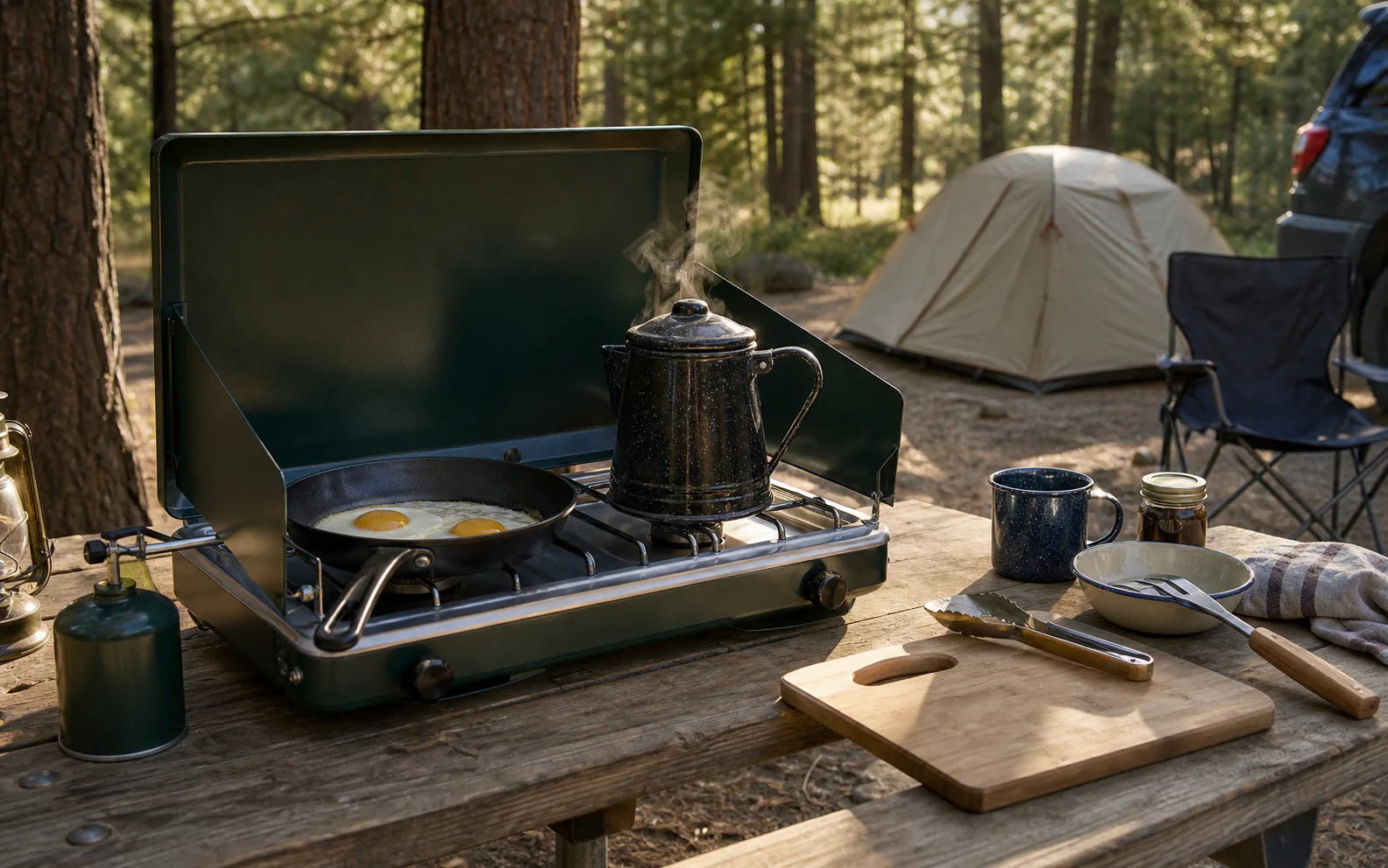
For car camping, most people should begin with a two-burner propane stove. It lets you run coffee and eggs at the same time, gives you a stable platform for normal cookware, and feels familiar for anyone who cooks at home. Compact backpacking stoves still belong in the kit for quick water, backup use, or minimalist trips, but they are not as pleasant for family meals. The right stove depends on whether you value raw heat output, simmer control, packed size, cleanup, or a kitchen system that nests with cookware.
Best Overall Direction
The Camp Chef Everest 2X is popular because it brings serious heat in a briefcase-style stove. Camp Chef lists two 20,000 BTU burners, 40,000 total BTU, 215 square inches of cooking area, and a 12 pound weight. Those numbers make sense for people who cook real meals at camp: pasta water, cast-iron breakfast, fajitas, or big pots that punish weaker burners. The tradeoff is fuel appetite and price. If you mostly reheat soup, a lower-output stove may be enough.
Best Mainstream Pick
The Coleman Cascade 222 is a more moderate two-burner propane stove. Coleman lists 22,000 total BTU, two adjustable burners, Instastart ignition, a 13.05 pound weight, and 22 by 13.2 by 3.7 inch dimensions. It also fits one 12 inch and one 10 inch pan, which is a practical note because pan fit matters more than many buyers expect. The Cascade 222 makes sense for families who want familiar Coleman usability with better control than the most basic budget stoves.
When High BTU Helps
High BTU output is useful for boiling large pots, fighting wind, and cooking with heavier pans. It is less useful if the stove cannot simmer or if the flame pattern creates hot spots. A breakfast skillet needs control, not just power. Wind screens also matter. Even a strong burner can perform poorly when gusts push heat around the pot. In exposed desert or alpine campgrounds, a stove with a sturdy lid and side windscreens can feel much more capable than a stove with similar specs but weaker shielding.
Cooking Surface and Pan Fit
Before buying, picture your actual cookware. A ten-inch skillet and a coffee pot fit on almost anything. A twelve-inch cast-iron pan plus a saucepan may crowd many compact stoves. Wider stoves are more comfortable, but they take more table space and pack bulkier. Families and overlanders often appreciate extra cooking area. Minimalist car campers may prefer a compact stove that stores cleanly in a kitchen box.
Fuel Planning
Most two-burner camp stoves use one-pound propane cylinders unless adapted to a larger tank. One-pound bottles are convenient but create waste and can run out during group meals. Larger refillable propane tanks are better for frequent campers, though they require hose management and more storage space. Backpacking stoves use isobutane-propane canisters, which are compact and convenient for boiling water but less suited to broad pans unless the stove system includes support.
Maintenance
A stove that is easy to clean gets used more. Look for removable grates, accessible drip trays, sturdy latches, and knobs that do not feel fragile. Wipe food spills before storage because grease attracts dirt and can make the next trip unpleasant. Check regulators, hoses, and canisters before leaving home. Outdoor cooking is simple until a tiny missing piece keeps breakfast from happening.
Bottom Line
Buy the stove around your meals. If camp cooking is part of the trip, invest in a stable two-burner propane stove with enough space and control. If food is mostly dehydrated meals and coffee, a compact burner can be enough. The best camp stove is the one that matches the real rhythm of your campsite, not the one with the most impressive number printed on the box.
Source Notes
- Camp Chef lists the Everest 2X at two 20,000 BTU burners, 40,000 total BTU, 215 square inches of cooking area, and 12 lb.
- Coleman lists the Cascade 222 at 22,000 total BTU, two burners, propane fuel, and 22 x 13.2 x 3.7 inch dimensions.
FAQ
How many BTUs do I need for car camping?
For two-burner propane stoves, roughly 10,000 BTU per burner is common, while higher-output models can boil faster and resist wind better but use more fuel.
Is a backpacking stove enough for car camping?
It can be enough for boiling water or solo meals, but a two-burner stove is much easier for family breakfasts, skillet meals, and coffee at the same time.
Should I choose propane or isobutane?
Propane is convenient for car-camping two-burner stoves. Isobutane canisters are common for compact backpacking stoves and fast-boil systems.